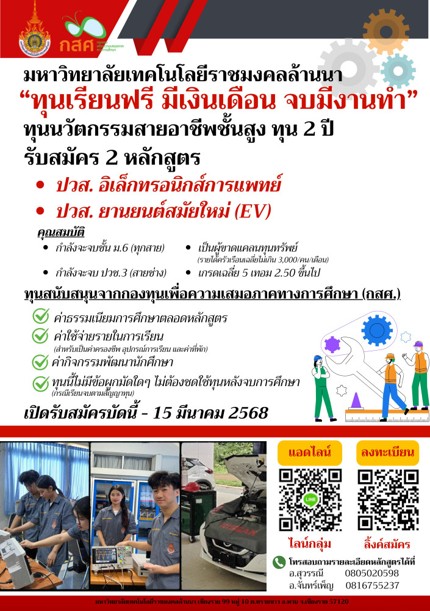
The High Vocational Innovation Scholarship Program, supported by Thailand’s Equitable Education Fund (EEF), aims to expand access to vocational education for students from low-income and disadvantaged backgrounds. The program provides financial assistance and educational opportunities to students with academic potential who face financial barriers to continuing their education.
Through collaboration among educational institutions, government agencies, and private-sector partners, the program supports the development of technical knowledge, practical skills, and professional competencies aligned with labor market needs. It also aims to improve students’ employment prospects and long-term economic well-being, contributing to poverty reduction and sustainable workforce development.
In academic year 2025 (B.E. 2568), Rajamangala University of Technology Lanna (RMUTL), in collaboration with the EEF, continued implementing the High Vocational Innovation Scholarship Program under the Innovative Educational Institutions (Continuous Innovation) initiative, Cohort 7.
The program supports RMUTL’s mission to develop skilled graduates with competencies in technology and innovation, particularly in fields relevant to industrial development and emerging technologies.
The program offers two scholarship pathways:
1. Five-Year Scholarship (Vocational Certificate to Higher Vocational Certificate)
This scholarship is designed for students completing Grade 9 (Mathayom 3) or an equivalent qualification who wish to pursue a continuous five-year vocational education pathway.
The scholarship supports students from the Vocational Certificate (Por Wor Chor) level through the Higher Vocational Certificate (Por Wor Sor) level, particularly in pre-engineering and electric vehicle technology.
2. Two-Year Scholarship (Higher Vocational Certificate or Associate Degree)
This scholarship is intended for students completing Grade 12 (Mathayom 6), the third year of a Vocational Certificate program, or an equivalent qualification.
At RMUTL, the program provides opportunities for students to pursue specialized vocational education in fields such as Electric Vehicle Technology and Electronics (Medical Technology).
| Scholarship Type | Monthly Allowance |
|---|---|
| Five-year scholarship: First three years (Vocational Certificate level) | THB 6,500 |
| Five-year scholarship: Final two years (Higher Vocational Certificate level) | THB 7,500 |
| Two-year scholarship (Higher Vocational Certificate or Associate Degree) | THB 7,500 |
In addition to scholarship funding, RMUTL provides student accommodation and promotes income-generating activities to help reduce living expenses and support students throughout their studies.
Student Accommodation Support
RMUTL provides student dormitories and accommodation services to improve access to safe and affordable housing, particularly for students from low-income families and those who live far from campus. These facilities help reduce the financial burden of housing and transportation, enabling students to focus on their education and participate more fully in university activities.
Accommodation support is subject to availability and the policies of each campus.
Income-Generating Activities During Study
RMUTL also promotes opportunities for students to earn additional income while studying through part-time employment, practical training, student entrepreneurship, and university-supported activities.
These opportunities allow students to apply their academic knowledge and technical skills in real-world settings while developing professional competencies, entrepreneurial skills, and work experience. Income generated through these activities can help students cover daily living expenses, reduce their dependence on family financial support, and prepare for future employment.
The scholarship selection process emphasizes equitable access, financial need, academic potential, and transparency.
Participating institutions conduct outreach activities to identify eligible students from low-income and disadvantaged backgrounds. Applicants undergo financial and academic assessments, including household income screening, verification of disadvantaged status, and evaluation of their suitability for the selected vocational programs.
Successful applicants must complete the required documentation and sign a scholarship agreement before receiving financial assistance.
In academic year 2025 (B.E. 2568), RMUTL implemented the High Vocational Innovation Scholarship Program, Cohort 7, in collaboration with the EEF to expand educational opportunities for financially disadvantaged students.
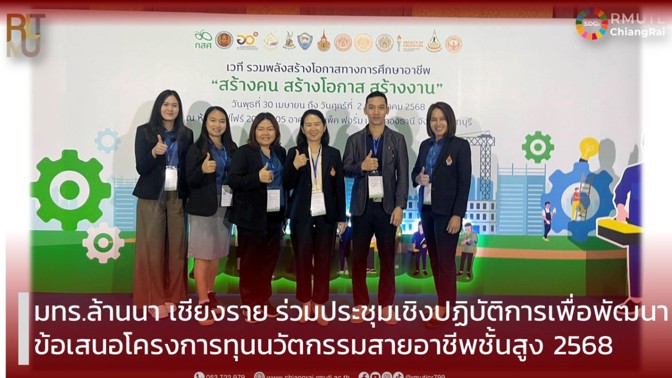
RMUTL Chiang Rai Campus received an additional allocation of 25 scholarships for students pursuing higher vocational education in two specialized fields:
The campus conducted scholarship recruitment, household financial assessments, eligibility screening, and selection procedures to identify qualified applicants from economically disadvantaged backgrounds.
These initiatives demonstrate RMUTL’s continued efforts to provide targeted educational assistance and expand access to technical and vocational education for students facing financial constraints.
The High Vocational Innovation Scholarship Program reflects RMUTL’s commitment to promoting educational equity and sustainable development by expanding opportunities for students from low-income and disadvantaged backgrounds. Through scholarships, monthly living allowances, and professional skills development, the program helps reduce financial barriers to education and supports students in completing their vocational qualifications.
In addition to financial assistance, RMUTL provides student accommodation and promotes income-generating activities during study. These measures help reduce living expenses, ease the financial burden on students and their families, and provide opportunities to gain practical experience, develop professional competencies, and strengthen financial independence.
The university also adopts a systematic approach to supporting financially disadvantaged students through household financial assessments, targeted scholarships, and collaboration with national education funding agencies. These mechanisms help ensure that educational assistance reaches students in need and supports their continued participation in education.
By integrating financial assistance, affordable accommodation, practical skills development, and income-generating opportunities, RMUTL aims to improve student retention, support successful completion of studies, and enhance graduates’ long-term employment prospects. This approach contributes to sustainable educational opportunities, improved quality of life, and the reduction of intergenerational poverty among students and their families.
References
The Phra Kanit Sammajiv Scholarship Program, supported by Thailand’s Equitable Education Fund (EEF), provides educational opportunities for academically talented students from low-income and disadvantaged backgrounds. The program supports students in pursuing higher education, with opportunities to continue their studies from the bachelor’s degree level through master’s and doctoral programs, depending on their academic potential and the scholarship’s conditions.
The program aims to reduce financial barriers to higher education, recognize academic excellence and outstanding abilities, and develop highly skilled graduates in fields aligned with national workforce needs. It also promotes educational equity and long-term career development, enabling students to improve their quality of life and contribute to sustainable social and economic development.
Rajamangala University of Technology Lanna (RMUTL) supports the program by encouraging eligible students to apply for scholarships and pursue higher education in engineering, technology, agriculture, and other relevant fields.
Applicants for the 2025 scholarship program must meet the following requirements:
The EEF prioritizes bachelor’s degree programs that contribute to national workforce development and provide opportunities for advanced education in the following areas:
The EEF also considers whether the selected bachelor’s degree program provides a suitable academic pathway for further study at the master’s or doctoral level.
In 2025 (B.E. 2568), the EEF accepted online scholarship applications from November 29 to December 29, 2025. The selection process involved a committee of experts representing four sectors: academia, the private sector, public policy, and mass media.
A total of 41 applicants nationwide were selected under the scholarship program, according to the reported selection results.
Of these, nine students from Rajamangala University of Technology Lanna (RMUTL) were selected to receive the Phra Kanit Sammajiv Scholarships.
The selected RMUTL students represented two campus areas and several academic disciplines, as summarized below.
| Campus Area | Field of Study | Number of Scholarship Recipients |
|---|---|---|
| Chiang Mai | Mechanical Engineering | 1 |
| Chiang Mai | Computer Engineering | 2 |
| Chiang Mai | Medical Electronics Engineering | 5 |
| Lampang | Plant Science | 1 |
| Total | 9 |
Eight scholarship recipients were enrolled in the Faculty of Engineering at RMUTL Chiang Mai Campus, while one recipient was enrolled in the Faculty of Science and Agricultural Technology at RMUTL Lampang Campus.
The selection of these students recognizes their academic achievements, potential, and commitment to pursuing higher education in fields that contribute to technological advancement, agricultural development, and national workforce needs.
The Phra Kanit Sammajiv Scholarship Program reflects RMUTL’s commitment to promoting educational equity and supporting talented students from financially disadvantaged backgrounds. By providing pathways to higher education and opportunities for continued academic development, the program helps students overcome financial barriers and achieve their educational goals.
The program also encourages academic excellence, leadership, social responsibility, and professional development. These opportunities enable scholarship recipients to strengthen their knowledge and practical competencies while preparing for employment, advanced study, and future contributions to their communities.
Through collaboration with the EEF, RMUTL seeks to develop highly qualified graduates in engineering, technology, agriculture, and other fields essential to national development. This approach supports long-term career opportunities, improves students’ prospects for economic stability, and contributes to reducing intergenerational poverty.
The program demonstrates the university’s continued commitment to developing skilled professionals and promoting inclusive, sustainable social and economic development.

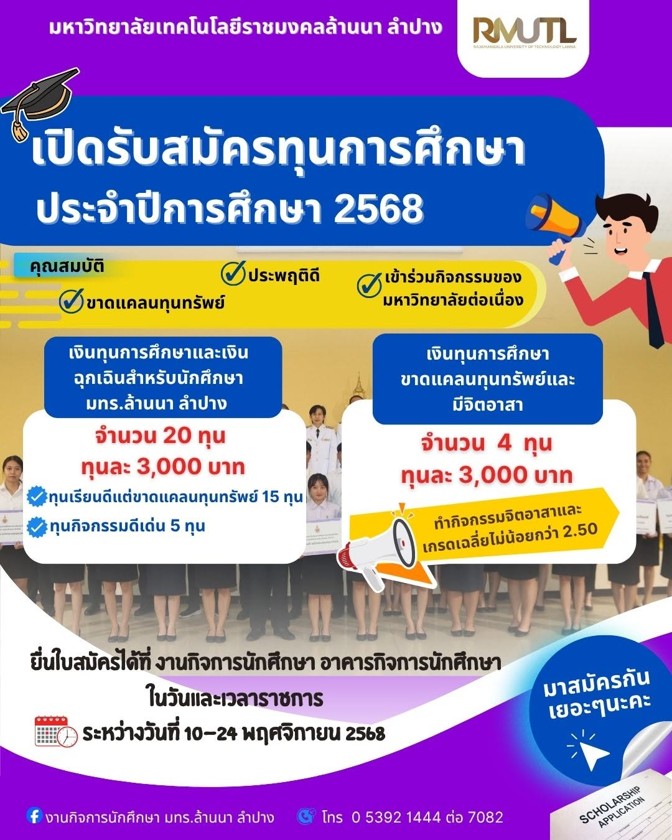
Rajamangala University of Technology Lanna (RMUTL) provides scholarships, student loans, emergency financial assistance, and other support measures to improve access to higher education and reduce financial barriers for students from low-income and disadvantaged backgrounds.
These programs support students at different stages of their education, from admission through graduation. By combining financial assistance with academic support and career development opportunities, RMUTL aims to improve student retention, facilitate successful completion of studies, and enhance graduates’ long-term economic prospects.
In academic year 2025 (B.E. 2568), RMUTL provided financial assistance through non-repayable scholarships and the Student Loan Fund (SLF). The university’s records identify 527 recipients of non-repayable grants, totaling THB 4,496,500. In addition, detailed loan records for 1,700 continuing borrowers in the Chiang Mai campus area show financial support totaling THB 25,221,550.
Table 1. Scholarships and Living-Support Funds by Type, Academic Year 2025
| No. | Scholarship or Assistance Type | Students Supported | Amount (THB) |
|---|---|---|---|
| Group 1: Non-Repayable Grants | |||
| 1.1 | Kaew Yot Kham Lanna Graduate Scholarship | 6 | 820,000 |
| 1.2 | Academic Excellence Scholarships | 326 | 1,630,000 |
| 1.3 | Chaloem Ratchakumari Scholarships | 44 | 1,180,500 |
| 1.4 | Scholarships for Financially Disadvantaged Students with a Commitment to Community Service | 1 | 24,000 |
| 1.5 | Emergency Financial Assistance for Students Experiencing Severe Hardship | 92 | 580,000 |
| 1.6 | Awards for Outstanding Student Activities | 58 | 262,000 |
| Total, Group 1 | 527 | 4,496,500 | |
| Group 2: Student Loan Fund (Continuing Borrowers, Chiang Mai Campus Area) | |||
| 2.1 | Financially Disadvantaged Students | 707 | 9,782,550 |
| 2.2 | Financially Disadvantaged Students in High-Demand Fields | 938 | 14,751,500 |
| 2.3 | Financially Disadvantaged Students in Fields Experiencing Workforce Shortages or Receiving Special Promotion | 55 | 687,500 |
| Total, Group 2 | 1,700 | 25,221,550 | |
The 527 non-repayable grant recipients represent approximately 3.43% of RMUTL’s 15,352 students in academic year 2025. The 1,700 continuing borrowers recorded in Group 2 represent approximately 11.07% of the university’s student population.
Together, these two groups account for 2,227 financial assistance records, equivalent to approximately 14.51% of the student population. However, this combined figure should not be interpreted as the number of unique beneficiaries unless potential overlaps between scholarship recipients and student loan borrowers have been verified.
These financial assistance mechanisms help students manage educational and living expenses, reduce the risk of withdrawal due to financial difficulties, and continue their studies toward graduation.
The Student Loan Fund (SLF) is an important financial support mechanism for students who meet the eligibility requirements. It provides access to educational loans to help cover tuition fees, educational expenses, and eligible living costs.
In academic year 2025, a total of 3,714 RMUTL students across six campus areas were registered as SLF borrowers. This included 2,955 continuing borrowers and 759 new borrowers.
Table 2. Student Loan Fund Borrowers by Campus Area, Academic Year 2025
| Campus Area | Continuing Borrowers | New Borrowers | Total Borrowers |
|---|---|---|---|
| Chiang Mai | 1,747 | 405 | 2,152 |
| Tak | 478 | 155 | 633 |
| Chiang Rai | 254 | 64 | 318 |
| Phitsanulok | 223 | 58 | 281 |
| Lampang | 136 | 45 | 181 |
| Nan | 117 | 32 | 149 |
| Total | 2,955 | 759 | 3,714 |
Chiang Mai Campus accounted for the largest proportion of SLF borrowers, with 2,152 students (57.94%), followed by Tak Campus with 633 students (17.04%). The remaining borrowers were distributed across Chiang Rai, Phitsanulok, Lampang, and Nan.
RMUTL operates in six northern provinces, including areas where students and their families may face economic challenges associated with agricultural income uncertainty, limited employment opportunities, and geographic barriers to education.
Access to student loans is particularly important for students from rural, remote, and economically disadvantaged communities. By reducing the immediate financial burden of higher education, the SLF enables eligible students to continue their studies and develop the knowledge and skills needed for future employment.
The proportion of new borrowers provides an indication of how widely the Student Loan Fund continues to reach students who are entering the loan system.
Table 3. New Student Loan Fund Borrowers by Campus Area, Academic Year 2025
| Campus Area | Continuing Borrowers | New Borrowers | Total Borrowers | New Borrowers (%) |
|---|---|---|---|---|
| Chiang Mai | 1,747 | 405 | 2,152 | 18.82% |
| Tak | 478 | 155 | 633 | 24.49% |
| Chiang Rai | 254 | 64 | 318 | 20.13% |
| Phitsanulok | 223 | 58 | 281 | 20.64% |
| Lampang | 136 | 45 | 181 | 24.86% |
| Nan | 117 | 32 | 149 | 21.48% |
| Total | 2,955 | 759 | 3,714 | 20.44% |
Lampang and Tak recorded the highest proportions of new borrowers, at 24.86% and 24.49%, respectively. Approximately one in four borrowers in these campus areas entered the student loan system as new borrowers in academic year 2025.
Across all six campus areas, new borrowers accounted for 20.44% of the total, indicating that the SLF continued to provide financial assistance to students entering the borrowing system.
Although these figures demonstrate the distribution of financial assistance, the proportion of new borrowers alone does not establish changes in household poverty or economic conditions. Additional socioeconomic information would be required to assess the relationship between borrowing patterns and financial hardship.
Based on the average financing amount recorded for continuing borrowers in the Chiang Mai campus area, RMUTL’s institutional report estimated total SLF financing across all six campus areas at approximately THB 55.10 million. This estimate includes approximately THB 43.84 million for continuing borrowers and THB 11.26 million for new borrowers.
These estimated amounts illustrate the potential scale of student loan financing across the university. However, they should be distinguished from verified loan disbursement records because the university-wide figures were derived through statistical extrapolation.
RMUTL recognizes that financial difficulties can affect students in different ways and over different periods. To provide appropriate assistance, the university considers three broad forms of poverty: short-term, medium-term, and long-term poverty.
Table 4. Types of Financial Hardship and RMUTL Support Measures
| Category | Short-Term Poverty | Medium-Term Poverty | Long-Term Poverty |
|---|---|---|---|
| Description | Temporary financial hardship caused by unexpected events, such as natural disasters, illness, job loss, or family emergencies | Prolonged financial difficulties associated with limited household income, unstable employment, or economic constraints | Persistent economic disadvantage associated with limited access to resources, education, and employment opportunities |
| Principal Support Measures | Emergency grants and short-term financial assistance | Student loans and other financial support | EEF scholarships and long-term educational assistance |
| Additional Support | Other internal and external scholarships | Other internal and external scholarships | Other internal and external scholarships |
Students experiencing financial hardship may apply for different types of assistance, subject to the eligibility requirements and conditions of each program.
In 2025, flooding and other natural disasters affected families in several northern provinces, causing damage to homes, agricultural land, and household property. Students from farming households were particularly vulnerable to income losses resulting from crop damage and interruptions to agricultural activities.
For students experiencing sudden financial difficulties, emergency assistance can help cover immediate needs and reduce the risk of interrupting their education.
RMUTL also reviews applications for scholarships, living allowances, and student loans through established screening procedures. Financial assessments consider household income and other circumstances affecting students’ ability to pursue higher education.
The university’s institutional assessment framework identifies five dimensions of student well-being:
These dimensions provide a basis for identifying financial and nonfinancial barriers that may affect students’ educational participation and academic progress.
Household income assessments are particularly important for identifying students from low-income backgrounds. The university also considers relevant national poverty measures and the specific eligibility requirements established by scholarship providers and government funding agencies.
RMUTL serves six provinces in northern Thailand: Chiang Mai, Chiang Rai, Lampang, Nan, Tak, and Phitsanulok. Several of these provinces include rural, mountainous, and border communities where access to educational resources and economic opportunities may be limited.
The university’s geographic coverage provides opportunities to support students from diverse socioeconomic and cultural backgrounds, including ethnic communities, migrant families, and other disadvantaged populations.
Students from these communities may experience additional barriers related to household income, distance from educational institutions, transportation costs, and access to social services.
To address these challenges, RMUTL promotes inclusive educational opportunities through scholarships, student loans, emergency financial assistance, accommodation support, and practical skills development.
The university also emphasizes applied learning and career-oriented education to help students develop the professional competencies required for employment and entrepreneurship.
Through these initiatives, RMUTL aims to expand access to higher education, improve students’ quality of life, and strengthen their ability to achieve long-term economic stability.
In addition to scholarships and financial assistance, RMUTL promotes cooperative education, work-based learning, and opportunities for students to earn income while studying.
Cooperative education enables students to gain practical experience in professional workplaces through partnerships with private-sector organizations. These experiences help students apply academic knowledge, develop technical and professional skills, and prepare for employment after graduation.
Table 5. Students Enrolled in Cooperative Education Courses, Academic Year 2025 (B.E. 2568)
| Faculty / College | Chiang Rai | Chiang Mai | Tak | Nan | Phitsanulok | Lampang | Total |
|---|---|---|---|---|---|---|---|
| Business Administration and Liberal Arts | 24 | 339 | 136 | – | 3 | 5 | 507 |
| Interdisciplinary and Technological College | – | 30 | – | – | – | – | 30 |
| Science and Agricultural Technology | – | – | 30 | 37 | 8 | 8 | 83 |
| Engineering | 51 | 424 | 258 | 43 | – | 14 | 790 |
| Fine Arts and Architecture | – | 25 | – | – | – | – | 25 |
| Total | 75 | 818 | 424 | 80 | 11 | 27 | 1,435 |
In academic year 2025, a total of 1,435 students were enrolled in cooperative education courses across RMUTL’s six campus areas. The Faculty of Engineering accounted for the largest number of participants, with 790 students, followed by the Faculty of Business Administration and Liberal Arts, with 507 students.
Through cooperation with industry partners, students gain workplace experience and may receive financial compensation or other forms of support, depending on the arrangements of their cooperative education placements.
RMUTL also promotes opportunities for students to earn additional income through part-time employment, student entrepreneurship, practical training, and university-supported activities.
The university has identified opportunities for financially disadvantaged students to work in supporting roles, including laboratory assistance, research assistance, and academic or student activity support.
These initiatives are intended to help students manage living expenses while developing practical competencies, professional responsibility, and financial independence.
RMUTL provides emergency financial assistance to students experiencing severe hardship or unexpected circumstances that may disrupt their education.
In academic year 2025, 92 students received emergency or hardship assistance totaling THB 580,000.
Under the university’s 2024 financial assistance announcement, eligible students affected by serious disasters, including floods, fires, storms, and earthquakes, may receive financial support of up to THB 20,000, subject to the applicable requirements.
The university also provides student accommodation services and promotes access to affordable housing to reduce living expenses, particularly for students from low-income families and those who live far from campus.
Together with scholarships, student loans, and income-generating opportunities, these support measures help students manage financial difficulties and continue their education.
RMUTL adopts an integrated approach to student financial support by combining scholarships, student loans, emergency assistance, accommodation services, and opportunities for professional development and income generation.
These measures address both immediate financial needs and longer-term barriers to educational participation. Scholarships and emergency assistance help students manage educational and living expenses, while student loans provide an additional source of financial support for eligible students.
Cooperative education, practical training, and income-generating activities complement these measures by helping students develop professional skills, gain workplace experience, and prepare for future employment.
Through systematic financial assessments, targeted assistance, and collaboration with government agencies, educational institutions, and private-sector partners, RMUTL seeks to improve access to higher education and support students throughout their academic journey.
This approach reflects the university’s commitment to educational equity, improved quality of life, and sustainable human capital development. By helping students complete their education and strengthen their employment prospects, RMUTL aims to support long-term economic stability and reduce the risk of intergenerational poverty.
Further Information
RMUTL Student Scholarship and Financial Assistance Services:
https://dsd.rmutl.ac.th/page/scholarship